Nine Men In Gray by Charles L. Dufour
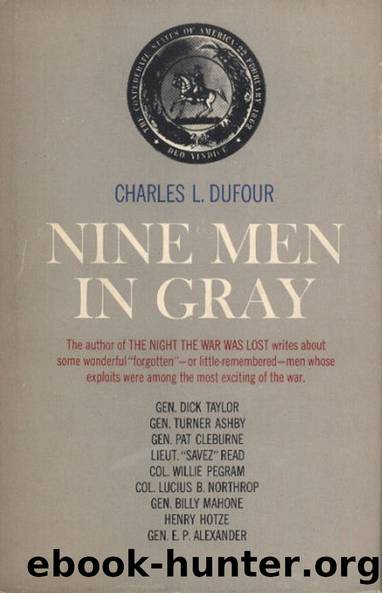
Author:Charles L. Dufour [Dufour, Charles L.]
Language: eng
Format: epub
Tags: History, United States, Civil War Period (1850-1877), Military, Modern, 19th Century
ISBN: 9781786254344
Google: 4T5vCwAAQBAJ
Publisher: Pickle Partners Publishing
Published: 2015-11-06T02:57:32+00:00
VI
The winter of 1862-63 was a dreary one for the Army of Northern Virginia. There was bitter cold, much rain, sleet and snow, and it was difficult to keep the men warmly clothed and shod and the horses fed.
There was considerable sickness in Leeâs camps, although many of the men reported on the sick lists were actually too poorly clad to face exposure to the elements on the more miserable days. At an inspection in February 1863, Willie Pegramâs battery of 171 officers and men reported 55 men sick. {256}
Pegramâs battery, after Fredericksburg, was stationed at Bowling Green, on the railroad to Richmond, and frequently it was sent on picket duty to Port Royal on the Rappahannock. As usual, when he wasnât blazing away with his beloved guns, Captain Pegram was bored. âEverything is quiet and dull in this region,â he wrote his sister Jennie from the vicinity of Port Royal on January 8, 1863. He had hoped for a furlough to visit the family, âbut General Lee is turning down all requests. I very cheerfully submit to this,â wrote Willie, âfor I know that General Lee has the interest of the service at heart & will do whatever is right.â Having read the newspapers of that date, Willie made two astute observations to his sister. Speaking of the Battle of Murfreesboro, fought in Tennessee at the turn of the year, he said: âBraggâs victory, like all our western victories, turned out to be scarcely any victory at all.â The other comment he made concerned European intervention on behalf of the Confederacy. âI see that the Enquirer of today is again trying to induce the people to believe that France is going to recognize us!â he wrote. âWhat a pity! I have always been of the opinion that we would be better off in the end, to fight the battles out ourselves...Louis Napoleon is not going to interfere unless it will benefit the French people more than any other...â
Despiteâor indeed, because ofâhis aversion to the routine of camp life, Captain Pegram spent his time in looking after the comfort of his men in the cheerless weather. His close friend and later his adjutant, Gordon McCabe, described Pegramâs camp activities, in that frightful winter:
âOne of his first cares on going into winter quarters...was to assemble the men and say a few words to them concerning the importance of building a chapel and holding regular prayer-meetings, All these services he attended himself with earnest pleasure, and it was a common sight to see him sitting among his men in the rude log-chapel, bowing his young head reverently in prayer, or singing from the same hymn-book with some weather-beaten private, from whom he had ever exacted strictest military obedience. His discipline was, indeed, that of long-established armies. He justly considered it mercy in the end to punish every violation of duty, and he knew that men do not grow restive under discipline the sternest at the hands of officers who lead well in action.
Download
This site does not store any files on its server. We only index and link to content provided by other sites. Please contact the content providers to delete copyright contents if any and email us, we'll remove relevant links or contents immediately.
The Vikings: Conquering England, France, and Ireland by Wernick Robert(84379)
Ali Pasha, Lion of Ioannina by Eugenia Russell & Eugenia Russell(40318)
The Conquerors (The Winning of America Series Book 3) by Eckert Allan W(37983)
The Vikings: Discoverers of a New World by Wernick Robert(37006)
Cecilia; Or, Memoirs of an Heiress — Volume 1 by Fanny Burney(32636)
Cecilia; Or, Memoirs of an Heiress — Volume 2 by Fanny Burney(32010)
Cecilia; Or, Memoirs of an Heiress — Volume 3 by Fanny Burney(31996)
Empire of the Sikhs by Patwant Singh(23135)
The Secret History by Donna Tartt(19294)
Hans Sturm: A Soldier's Odyssey on the Eastern Front by Gordon Williamson(18649)
Cat's cradle by Kurt Vonnegut(15441)
Pimp by Iceberg Slim(14665)
Sapiens: A Brief History of Humankind by Yuval Noah Harari(14460)
Norse Mythology by Gaiman Neil(13458)
Talking to Strangers by Malcolm Gladwell(13439)
Leonardo da Vinci by Walter Isaacson(13411)
4 3 2 1: A Novel by Paul Auster(12511)
Underground: A Human History of the Worlds Beneath Our Feet by Will Hunt(12145)
The Radium Girls by Kate Moore(12093)
